The growing opportunity for UK food, beverage and ingredients producers to save BIG on their waste and energy….
Does your business operate in the food, beverage or ingredients sector?
If so, trading conditions are tough right now. The impact of international oil supplies has had significant knock-on effects to operational costs and margins.
Unlike domestic energy tariffs, commercial energy prices are not capped, which means that fluctuations (particularly price increases) are passed directly on to the business. Not only are direct energy costs a challenge, but indirect energy costs start to affect operations too. For example, the cost of hauling ingredients or delivering finished goods increases with the cost of diesel. Then there is the impact of hauling waste from site to be treated elsewhere, we have seen customers faced with fast rising haulage costs, in some cases doubling (or even higher) in recent months.
Retail customers do not typically accept prices doubling overnight, so margins end up taking the brunt of the impact.

So what can be done about it?
The organic rich waste that is generated by a food, drinks and ingredients business actually presents an incredible opportunity to disentangle your business from those price rises and associated risks.
Organic rich waste is an energy source.
If you can convert that waste/by-product into a useable energy source, such as biogas to offset natural gas or electricity usage, you can remove that portion of energy costs from your business.
Not only that, but in converting these organics to energy, you are removing the very thing that means it has to be hauled from site and treated elsewhere, saving on waste treatment costs too.
This double impact means there is a really good opportunity to install an onsite anaerobic digestion plant like the WASE EMR system and achieve really fast return on investment.
Most WASE customers see a 3-5 year return on investment for moving from hauled waste treatment to onsite EMR. With the recent rises in energy and waste-haulage costs, some customers have even seen a sub-2 year return!!
So why does the WASE system work so well in food, drinks and ingredients?
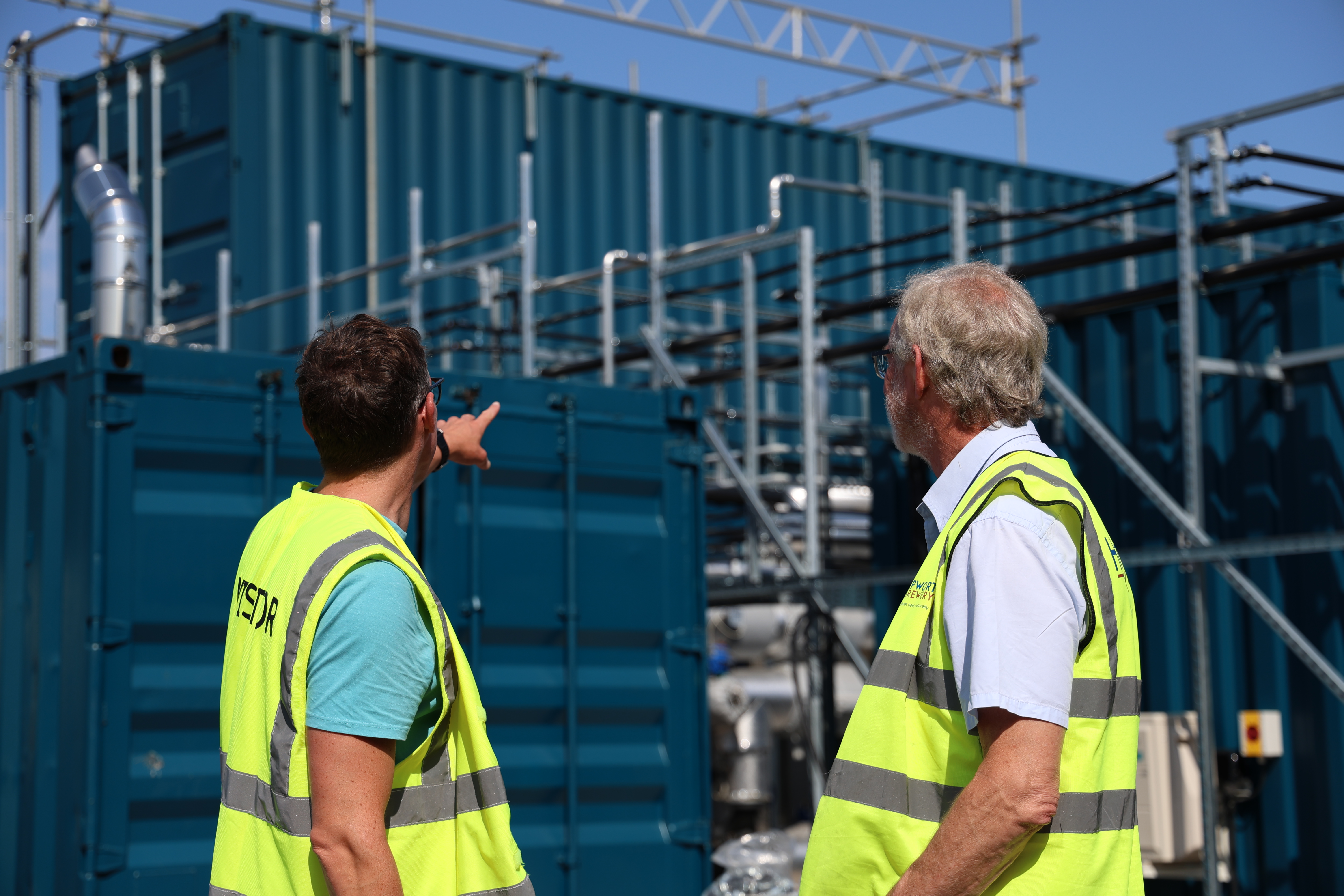
The WASE EMR system is a small, modular anaerobic digestion system that uses electrodes to enhance the organic breakdown process. This process we call Electro-methanogenesis or ‘EMR’ for short. The electrodes host some very special microbes that generate small amounts of electrical current, breakdown organic matter and convert them into a carbon neutral methane. Compared to a conventional anaerobic digestor, the whole process is:
- 3x faster
- Generates 30% more energy
- Can be installed in a much smaller area (typically 70% smaller footprint)
- Operates 24/7, 365 (unlike wind and solar)
- Helps reduce scope 1-3 emissions
- And is a ‘hands off’ operation, with real-time AI optimisation with the WASE Intelligence platform.
Because it is so fast, the plant can be small, making it suitable for many of the UKs food, drinks and ingredients producers as it can be tucked away in the corner of the site. Because it is so efficient, it can generate lots of useful energy helping improve the project economics. And finally, because the EMR process is so good at breaking down organics, it means that most waste streams it treats can be discharged to local drains or even back to the environment, removing the need for paid waste collections entirely. Check out our recent case study at Hepworth Brewery, which was recently featured in Forbes magazine: The Brewery Powering Itself From Its Own Waste
Interested to learn more?
Contact the team at WASE to learn more about the solution and its potential application at your business, we’d love to speak to you and help you on your waste and energy reduction journey!