Anaerobic digestion has long been framed primarily as an engineering challenge. But the plants that will lead the next era of performance are unlikely to be defined by hardware alone. They will be defined by how effectively they understand, interpret and act on the biology inside the process.
That is the shift WASE believes is now accelerating across the sector and looking to lead with its cutting edge biosensing and WASE intelligence platform.
As margins tighten, feedstocks become more variable and expectations on uptime and yield continue to rise, competitive advantage is moving away from reactive operations and toward data-led biological control. Remote data analytics and insights sit at the centre of that transition, giving operators not just more visibility, but a better basis for intervention, optimisation and commercial resilience.
Why traditional monitoring leaves operators exposed
Many anaerobic digestion facilities still rely heavily on periodic laboratory testing to assess digester health. Parameters such as volatile fatty acids, alkalinity, total solids, ammonia and digestate quality are often sampled on site and then sent away for analysis. While those tests are important, they also create a major operational challenge: time lag.
Between sample collection, transport, analysis and reporting, several hours or even days can pass before the operator has the information needed to make an informed intervention. In a biological process that can deteriorate quickly, that delay matters. By the time an elevated volatile fatty acid concentration or an emerging nutrient imbalance is confirmed, the digester may already be under stress and methane production may already have declined.
Research and industry analysis increasingly highlight the same problem: anaerobic digestion is highly sensitive to changing conditions, but conventional monitoring systems often struggle to anticipate disturbances. Recent reviews describe the process as nonlinear, multidimensional and vulnerable to surrounding changes, with limited sensor coverage and delayed feedback making optimisation difficult. Remote data analytics helps bridge that gap by combining continuously available plant signals, historical trends and predictive models into a live operational picture. Rather than asking only what happened in yesterday’s lab report, operators can begin asking what is changing now, what pattern it resembles, and what action should be taken before performance loss becomes visible in the energy yields.
The sensitivity of biological health to feedstock variation
Feedstock management is one of the most important and most difficult tasks in anaerobic digestion. Two loads of material may look similar on paper, yet differ significantly in dry matter, volatile solids, fat content, protein content, contaminants or biodegradability. Those differences directly affect organic loading rate (OLR), nutrient balance, foaming risk, ammonia release and microbial activity. Because the biology inside the digester responds to what is fed into it, even relatively small changes in substrate composition can have a dramatic effect on process stability. A feedstock shift that pushes the system too hard can lead to acid accumulation, inhibition or poor gas quality long before a manual trend review reveals what happened.
This is where remote analytics delivers real value. By linking feedstock records with process data such as temperature, pH, gas flow, methane concentration, loading rate, retention time and past performance, operators can see how different substrate mixes influence the biological system over time. Patterns that would otherwise be hidden become measurable. The facility can begin to identify which blends are robust, which combinations increase the risk of instability, and how the plant typically responds to seasonal or supplier-driven variation. Instead of depending solely on operator experience or isolated lab snapshots, remote analytics enables evidence-based feed planning that protects biological health while supporting higher and more consistent gas yield.
Making sense of many different data points
Anaerobic digestion operators do not manage a single variable. They manage an interconnected system. Biological indicators, feedstock characteristics, mechanical reliability, gas quality, utility consumption, digestate performance and combined heat and power output all influence the economic outcome of the plant. The challenge is not simply collecting data. Most facilities already have plenty of it in SCADA systems, spreadsheets, laboratory reports, operator logs and maintenance records. The real challenge is integrating those disparate data points into a whole-system assessment. A fall in methane percentage could be linked to feedstock change, temperature drift, mixing issues, a sensor fault, nutrient imbalance or gas handling problems. Looking at one dataset in isolation rarely tells the full story.
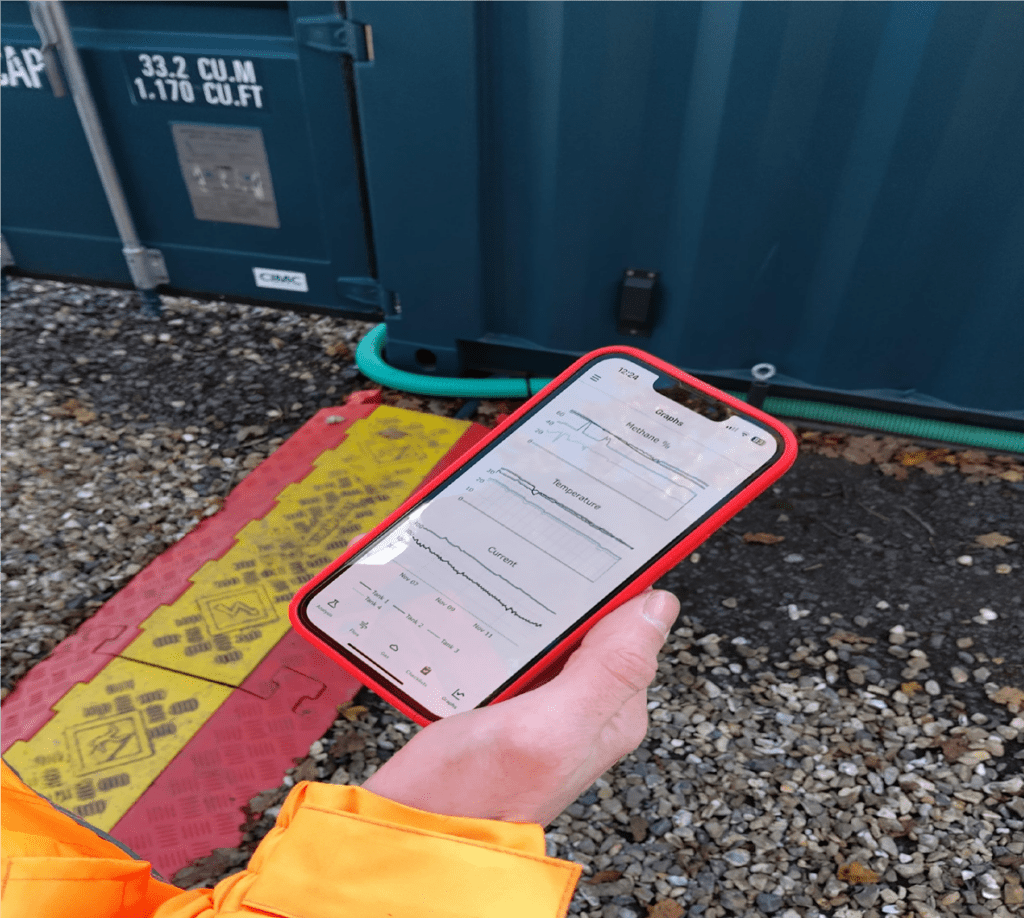
From WASE’s perspective, the value of remote analytics lies in turning disconnected plant and process information into practical operational intelligence. When online process measurements, laboratory values, feedstock records and equipment data are brought together in a structured way, operators are better able to distinguish symptom from cause. For example, a gradual pH drift can be connected to a recent increase in loading rate. Poor gas output can be assessed alongside retention time, substrate composition and known equipment constraints…but now imagine having direct feedback from the microbes and use their signals to inform pumping schedules, loading rates or even substrate quality?
With the right combination of monitoring, analytics and high power AI optimised process insight, a flood of disconnected numbers becomes a clearer picture of plant behaviour and can automate control interventions to ensure best possible performance.
How remote analytics supports process optimisation
The benefit of remote analytics is not only visibility but action-ability. When operators can track key indicators in near real time and compare them against expected biological behaviour, they can make faster and more confident decisions. Feeding regimes can be adjusted before overload conditions escalate. Mixing, heating and recirculation can be fine-tuned to support stable digestion. Maintenance teams can spot when mechanical issues are affecting process performance rather than treating them as separate problems. Remote access also allows technical specialists, consultants or central operations teams to review plant conditions without waiting for site visits, improving the speed and quality of support available to on-site staff.
Over time, the strongest platforms do more than display trends; they help forecast outcomes. By learning from historical plant behaviour, seasonal patterns and previous upset events, advanced analytics can identify deviations earlier than manual review alone. This does not mean removing experienced operators or lab validation tests. Instead this cloud based analytics (at WASE we call it ‘WASE Intelligence’) gives those teams insights for a stronger decision making. In practical terms, that means fewer surprises, better control of biological stress, improved consistency in gas production and a clearer understanding of which interventions actually move the needle. In a sector where revenue depends on stable throughput and dependable energy generation, that foresight has immediate and impactful commercial value.
New data opportunities
The WASE electro-methanogenic (EMR) process uses special microbes that live on electrodes inside the anaerobic environment, those microbes generate electrons that are passed onto the surface of the electrode and when we send them a voltage, they present a current response. The current that these microbes generate are a direct correlation to the health and happiness of those microbes. Over time WASE have built a series of AI models on our WASE Intelligence platform that have learned to interpret these electrical signals. The use cases for microbial feedback derived interventions are endless…
- The microbes can automate their feeding schedule based on the organic breakdown rate
- Pumps can be automatically stopped and alarms raised if microbes at the beginning of the process have a bad response to a feedstock (ie. unplanned or unwanted feedstocks)
- Temperatures can be optimised for maximum energy balance based on microbial activity
- Nutrients or additives can automatically be dosed based on microbial health status
Summary
For anaerobic digestion operators, the strategic value of remote analytics is now becoming impossible to ignore. It addresses one of the sector’s most persistent weaknesses: the gap between what is happening biologically inside the plant and when operators are able to see it clearly enough to respond. By reducing dependence on delayed laboratory feedback, AI and biosensing can expose the impact of feedstock variation on microbial performance and together with integration of multiple datasets into a usable whole-system view, remote analytics enables plants to operate with greater control and confidence.
The next frontier is even more significant. As AI and machine learning platforms mature, the real opportunity will not only be better diagnosis but in machine-learning-derived automated process interventions: systems capable of identifying an emerging upset, recommending or triggering a feeding, mixing, heating or recirculation adjustment, and continuously learning from the result. For many, this feels like a distant future, but we are achieving that today at WASE.
This means that for those adopting WASE intelligence systems, operators will be able to move from monitoring process health to orchestrating it dynamically. The prize is substantial: higher uptime, greater methane yield, stronger biological resilience, fewer unplanned disruptions and materially better revenues from gas generation.
At WASE, we see this as one of the most important opportunities in the future of anaerobic digestion: helping operators move from delayed, fragmented insight toward smarter, more responsive process control. For AD operators already dealing with slow interventions, feedstock-driven instability or disconnected data, the opportunity is available now. If these challenges resonate, contact WASE to discuss how WASE can help bring data-led optimisation, AI-enabled insight and stronger plant performance to life today.
You can find the team at wase.co.uk/get-in-touch/